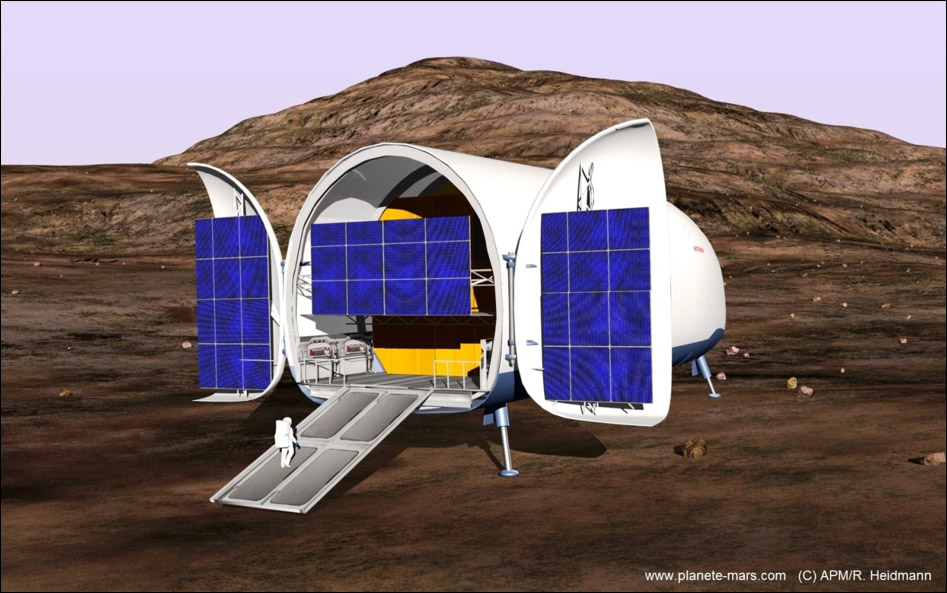

In September 2015 we issued a second release of our study about what could look like a MCT, taking into account most recent hints from SpaceX, especially its supposed preference for a single core launcher and for a dual launch to LEO (spaceship and refueling tanker).
Unfortunately, this second report, which shows a more convincing configuration than the first one, was published in French only on our website (planete-mars.com). A visitor of the Reddit website issued a translation, but this one was published rather as a forum entry than as a publication.
As numerous English speaking people visited the English part of our website to access the first release of our study (this one having been translated), we propose in this short paper a summary of the conclusions that we reached in this second phase. This synthesis gives:
- the principal configuration options which have been retained
- the main characteristics (dimensional, propulsive) of the Mars Shuttle and the launcher stage
- a series of renderings
Feel free to send your comments / questions through our website.
Richard Heidmann
Space Propulsion Engineer,
Vice-President Assocation Planète Mars, French chapter of The Mars Society
Principal configuration options
- Full reusability (launcher and Mars Shuttle)
- LOX-Methane propulsion for all manoeuvers except for attitude control and rescue capsule propulsion
- Mars Shuttle main engines in ventral position (to allow horizontal landing)
- Single stage launcher, with contribution of Shuttle propulsion system to achieve LEO
- Two launches to LEO:
- first: a Shuttle modified as a tanker (unmanned)
- then: the Mars Shuttle itself, with its 100 mT payload
- rendezvous and Mars Shuttle refueling
- Conjunction type return, to avoid big propellant storage tanks on Mars (with a 52 months duty cycle as a consequence…)
- Mars aerodynamic capture, in three steps: aerocapture, aerobraking, entry
- Aerodynamic formula: lifting body with only control fins (no wings), designed for both Mars and Earth entries
- Fully reusable metallic TPS (allowed by small ballistic coefficient)
- Mars horizontal landing (easier and safer unloading)
- Earth horizontal and propulsive landing (no wings, light undercarriage)
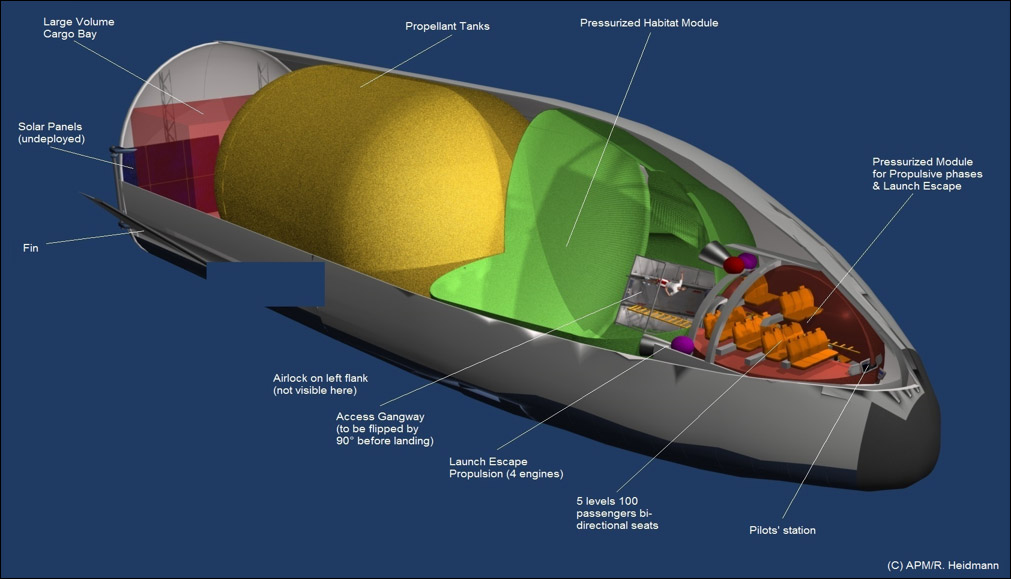
- During launches and landings, passengers stay in an emergency capsule, extractible through splitting Shuttle nose. Storable propellants. Propulsive landing.
- Possible use an auxiliary electric propulsion:
- at a low power level for easy integration in the Shuttle
- 100 kW, 6 mT incl. 4.5 mT of propellant
- reducing transfer durations (-50 days to Mars)
Main Characteristics
| Payload on Mars | |||
|---|---|---|---|
| 90 mT (Mars at perihelion), | including 100 passengers as a maximum | ||
| Launcher | |||
| GLOW | 7750 mT | ||
| Propulsion | 31 LOX-CH4 engines, sea-level thrust: 2940 kN, vac.Isp: 363s | ||
| Diameter | 12.5 m | ||
| Total height | 111 m (including Shuttle) | ||
| Shuttle | |||
| Length | 41 m | ||
| Diameter | 12 m | ||
| Dry mass | 109 mT | ||
| Propulsion | 4 LOX-CH4 engines (same as launcher), with extendable nozzles, vac.Isp: 380 sT | ||
| Tanks capacity | 1100 mT | ||
| Emergency capsule | |||
| Wet mass | 10 mT | ||
| Propulsion | 4 x 310 kN storable propellants, pressure-fed engines | ||
| Propellant mass | 1.6 mT |
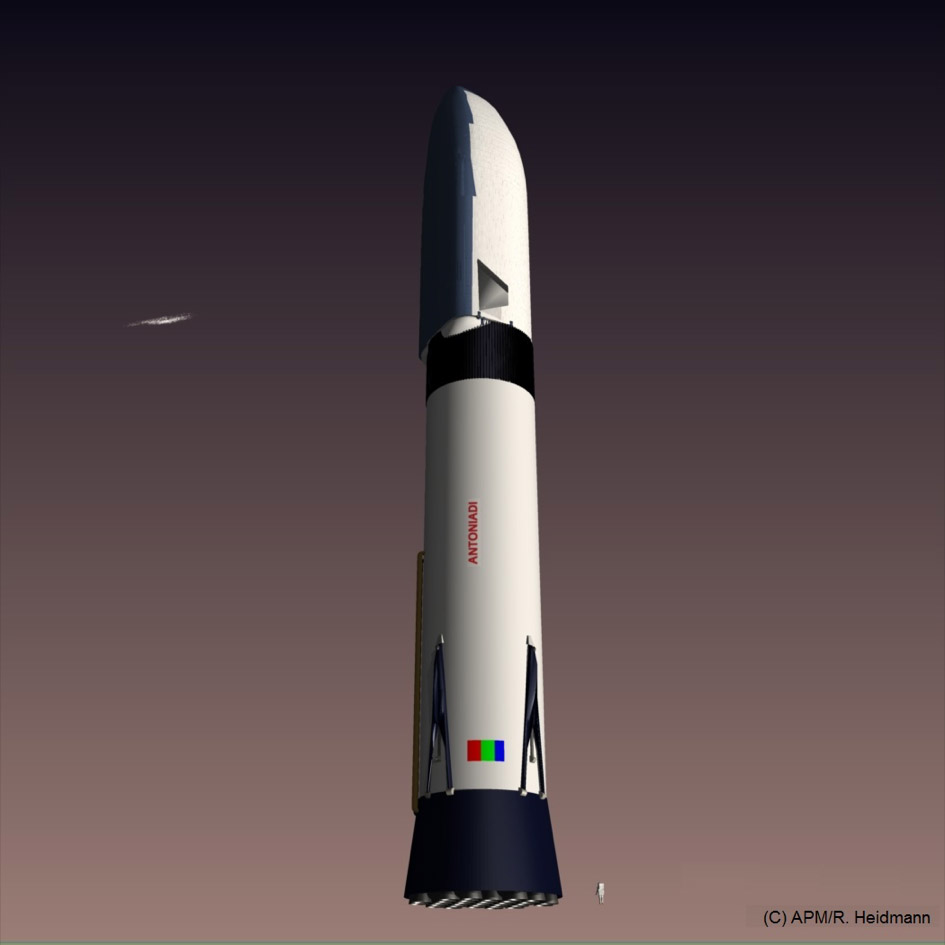
Note: the Raptor is said to be scaled at a 230T-thrust level. If this is confirmed, it could mean that the actual launch configuration is different from this one; or will the propulsion bay host an even greater pack of engines?